This short text comes from the second study block of the MA. I am not sure whether it relates to specific project, but it does position itself with work undertakien during the first study block. It is yet another example of my interest in working with image and text, semiology and language, pictures and words, and change. With hindsight, it does take a liberal view of the timing of the mirror stage.
"The living can assist the imagination of the dead."
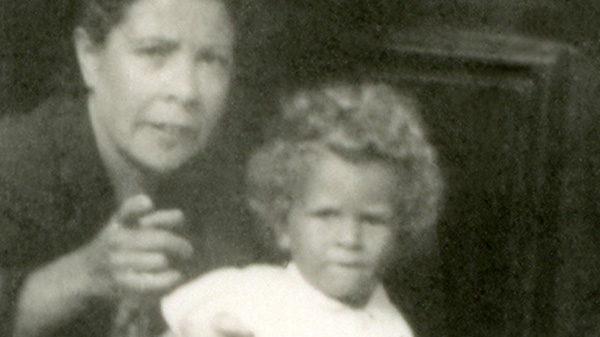 unidentified photographer, 'my mother and I', Clacton-on-Sea, 1952
I am frowning.
Am I confused, or do I not understand, or am I annoyed, or am I worried, or all or none of these, or am I experiencing something else unique to what Lacan calls the mirror stage, and its immediately previous hectic days and nights in my development of language, something for which there is not a word, because for me there were so few?
I say, “I am frowning”, in reference to the time within and around a photographic event that took place over 70 years ago; to the time that was the present during the photographic event in which I am seen to be frowning. I say ‘I’ as it is ‘I’ in this event. Time has not changed my agency here. I am older than the photograph; I am older than I am in this photograph. Neither can take away from the present that is in the photograph, the photographic event.
I am between 19 and 22 months old then. The location is Clacton-on-Sea. The person next to me is my mother. I only know this because I have seen her in other photographs; and I know that the child is me, as I’ve seen this child in photographs of my mother. We (now) do not know who is taking the photograph. Maybe it is likely that it is my father, but it could also be my aunt or uncle who lived locally, it could even be my sister or my cousin. I do not (now) know whether I ‘recognise’ the person being pointed out to me. In the photograph I am simply being alerted of them. And I am frowning.
It is between June and August 1952. Summer. My mother is wearing a summer frock under a jacket. I have a tan - (now) hopefully not sunburn.
I am frowning. I cannot know it, but then I am living in the interstitial zone between the Real and the Conceptual - in the process of, or actually beginning to come to terms (literally) with the ‘I’. Moving from a world of the purely sensate and iconic, to the world of Difference, the world the ‘I’ and the Other - language.
The haptic (I am being held in place, being directed towards a person with a camera); the iconic (the person with the camera to whom I am being pointed, and alerted of); together with (my) incipient language, are conspiring to cause my frowning. I cannot (now) know whether I am confused, uncomprehending, annoyed, all of these, or something entirely different in further combination; but I do (now) know that I am in a period of development dominated by a challenging state of flux; occasionally a traumatising state of flux, that is part of our emergence into a world of communication, and our abandoning the Maternal.
But how am I thinking, how am I seeing, how am I moving in the then of the photographic event, and in the now of my writing these words about that then?
Obviously, I can bring more to this image than you can, but that aside, fundamentally, all of you have also moved from the mirror stage into a world dominated by language. But what has this to do with photography?
I am frowning.
Risking a testy generalisation, we all have a practical understanding of the photograph as being something different from, say, a drawing; that the photograph has something to do with something that happened - cause and effect. We read photographs in a way that is different to the way that we read drawings. The pre-mirror child can take a photo, can make a drawing, but/and what is the intention there? What are the experiences and tools that we (now) use to read a photograph? They are both based on and in language. Language (and thus the photograph) cannot exist pre-mirror, unlike the sensate and the iconic.
I am frowning.
I find that there may be something alluring about the pre-mirror, about bathing in the tactile, the visual, and the Maternal, an inert Utopia. But also, as generally I have been able to communicate with other people, and I have a reasonable understanding of what is happening around me since leaving the mirror stage, it is terrifying to consider being incapable of communicating/understanding - the appalling shutting down and isolation I saw taking over in the latter stages of my sister’s terminal illness.
I am being instructed to look (smile) at the person who we know is holding the camera, but who, for me at that time, is just a (literally) familiar person, though not a familiarly stooping person. And in using language to direct me, my mother was also instructing me in the use of language itself, unwittingly deprecating the Maternal.
The image forms the background to the AV version of Always wear clean underwear; itself, and adaptation of a text from the series, Don’t tell stories, Adrian. that also includes Aunt Hilde: between waking and sleeping, and Elvis’ black soul. All of which unintentionally refer to the time around my mother’s death. It is as if there is something buried deep within me is trying to take me back to that time that is currently largely blocked off.
I did a lot of frowning as a child, and I have a feeling that I may have been chastised for that...