Stephen Shore: How to See (at MoMA in 2017)
This is a short (just over 3 minutes) clip from a video with Stephen Shore talking about How to See in the context of work displayed in the 2017 MoMA exhibition, Stephen Shore.
After two year's (or more) of retreat from city life, albeit comfortably shacked-up in the wide open spaces of Montana rather than a cave in a desert - two year's seeking subtle perceptions - Shore gains enlightenment and an understanding of landscape photography. Whatever that may mean.
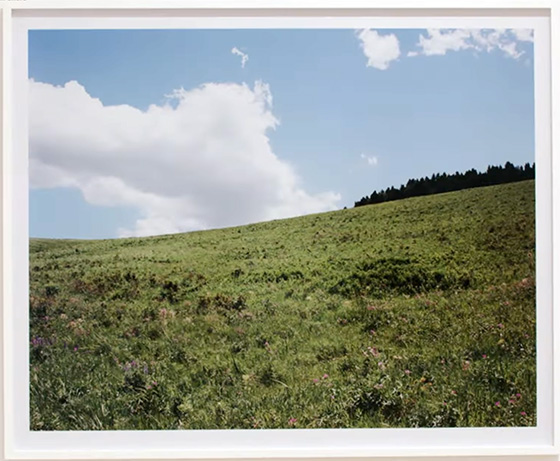 Stephen Shore at MoMA: is this large photograph in a small frame interesting?
a cropped still image from the above MoMA video
So, is the photograph behind Shore a photograph taken by a New Yorker, a city-dweller, or one who is expressing a perception of the place, a subtle perception of the place? And is it a photograph taken by a person who understands landscape photography, one who has the (subtle) perceptions needed to make interesting photographs?
This is all rather too mystical.
Indeed, is this hillside image actually an interesting photograph? Is it interesting in itself? Is it interesting as it is a photograph taken by Stephen Shore? Or is it interesting as it is a photograph on a wall in MoMA? Or is the photograph interesting because Stephen Shore tells us that it is interesting - a benediction? Or is it only an interesting photograph to a viewer who is also initiated in the art of subtle perceptions?
The photograph is significant as for well over one minute it shares the frame of view with Shore. But at no point is it specifically addressed by him.
The MoMA video is titled, How to see, though there seems no evidence of actual instructions in how to see, nor what seeing may mean in this lofty context, save for unhelpful "subtle perceptions"..
In another MoMA video in which he talks about the 2017 exhibition in an open forum, Shore states:
"[...] the photographs that I most admire [...] are pictures where the artist is not trying to make good pictures. They have visual problems that they want to solve. And it doesn't mean that they are not cogniscent of what's gone before in photography, in painting, in all other media; but they have certain problems that they want to solve, and they pursue it. And the results sometimes are what people, or culture might think of as good pictures. But good pictures are a by-product. It's not the motive." [Stephen Shore: MoMA Live (2017)]
There's a lot to unpack here. In the first few words we have, "admire", "pictures", "artist", "good pictures", "visual problems", "solve". But this is a famous person speaking informally, maybe...
Stephen Shore is keen to let us know that he teaches at a liberal arts institution, not a specialised art school. Bard College, ia a private liberal arts institution in rural upstate New York, with annual fees of around $92,000 (in 2025). The college's photography programme on which Shore teaches is described thus:
A photographer's growth is a product of the simultaneous development of three inter-dependent factors.
The first is gaining a conscious or intuitive understanding of the visual language of photography, that is, how the world is translated into a photograph and how a photograph orders in space and time the segment of the world that it shows. This is a photograph's grammar.
The second factor is the acquisition of technique. Without a technical foundation, expression is impossible; conversely, the broader the foundation, the greater the scope of expression. This is a photograph's vocabulary.
The third factor is the photographer's work on his or her self. This entails overcoming visual and psychological preconceptions and conditioning, deepening and clarifying perceptions, and opening up to one's emotions and finding one's passions. This is a photograph's content. It is the Photography Program's aim to offer instruction in this three-part process and to provide a historical and aesthetic framework for the student's development within the context of a broad-based liberal arts education.
This esoteric trinity - a photograph's grammar, a photograph's vocabulary, a photograph's content - forms the core of Shore's lavish book, The Nature of Photographs: A Primer. Or, more realistically, Mystifying Photography for Dummies.
Bard's dictum, "[...] overcoming visual and psychological preconceptions and conditioning, deepening and clarifying perceptions, and opening up to one's emotions and finding one's passions" is maybe an echo or an elaborated confirmation of Shore's "subtle perceptions". Either way, this is not something to which I can subscribe.
This is all far too mystical.
Maybe this is one of those instances where a person is so revered that they can say anything and remain above criticism? Or maybe, repurposing Bush's infamous utterance, "Americans don't have a word for conneries."