This is the critical journal entry for the very first topic of the first study block for the Fitzroy cohort in September 2022. The text is unchanged save for typos and accuracy.
Topic 1: Mirrors and Windows
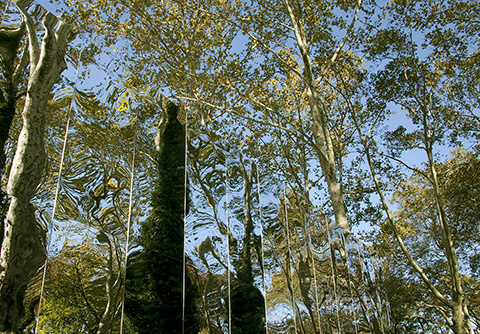
mirror wall, Zaha Hadid - Chanel Art Pavilion, Central Park, NYC, October 2008
On the Topic Forum I wrote: Up until 2009 I used to spend six months of the year away from UK on business; never really in one place for more than a few days, and with precious little time to go out and about. I was determined to avoid tourist hot spots, and even if I was at such a place, I found myself looking in a different direction to others. Here I was (obviously) interested in this enormous mirror wall under Autumn trees in Central Park, NYC. Behind the wall, and the main reason for people to be thereabouts, was the Zaha Hadid - Chanel Art Pavilion. This image from 2008 may be seen to illustrate where I was at the time, both metaphorically and physically, but it does not reflect my current interests - these are located in the interaction of image and text. It's here as it is an image of mirrors, and my past.
After thoughts: This was my first step into this new community, dubbed, Fitzroy. The image conveniently appropriate for the topic, while equally conveniently from my frantic past. I deliberately left out my destinations, the purposes of my business, and the identity of my employer.
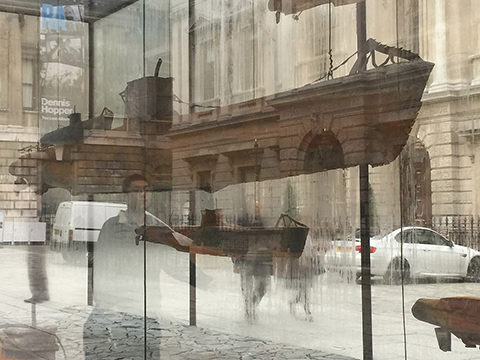
Anselm Kiefer, U-boat Vitrine, Royal Academy of Arts, 2016 (detail)
Reflection: Mirrors and Windows – through the Looking Glass
From the far end of the corridor, the mirror was watching us; and we discovered, with the inevitability of discoveries made late at night, that mirrors have something grotesque about them. [Borges, 1962, 6]
In the press release to the 1978 exhibition, Mirrors and Windows: Americam Photography since 1960, and seemingly unaware of radical developments in both home-grown American as well as “Continental” visual critical thinking, John Szarkowski can still be seen to be thinking in the same whimsical vein of his 1964 exhibition, The Photographer’s Eye:
In John Szarkowski's view, the dominant motif of American photography during the past 20 years has been a movement "from public to private concerns." Unlike the generation of the 1930s and 40s, Szarkowski suggests, the generation that came to artistic maturity and public recognition after 1960 is characterized by a pursuit of highly personal visions of the world rather than any attempt to offer a comprehensive program for social or aesthetic progress.
MIRRORS AND WINDOWS has been organized around Szarkowski's thesis that such personal visions take one of two forms. In metaphorical terms, the photograph is seen either as a mirror -- a romantic expression of the photographer’s sensibility as it projects itself on the things and sights of this world; or as a window -- through which the exterior world is explored in all its presence and reality. [MOMA (1), 1978]
In his exhibition catalogue essay [MOMA (2), 1978],Szarkowski cites two publications as exemplars of what he describes as the mirror-window dichotomy: Minor White's magazine, Aperture, and Robert Frank's book, The Americans. And in the introduction to the exhibition catalogue, he compares images from each book, side by side: Minor White's, Windowsill Daydreaming (1958), and Robert Frank's, Butte, Montana (1959).
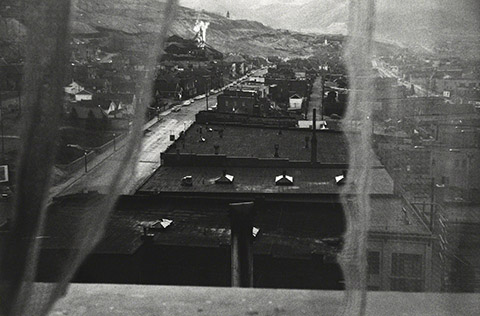
Butte Montana: Robert Frank (1959)
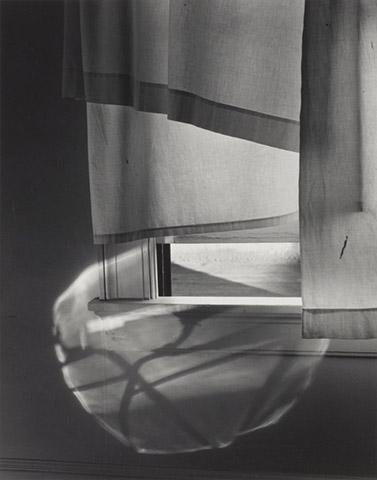
Windowsill Daydreaming, Rochester: Minor White (1958)
Hindsight allows me/us to dismantle Szarkowski’s seeming caprice.
By citing metaphor, I am colonising your knowledge, experience, and critical understanding of my binary opposition of a mirror-window classification of photography. Herein the mirror projects rather than reflects; and the sanitising one-way window-world places everything outside, elsewhere. In mirror-world the photographer is not in control of the photograph, rather, in spite of them, the photograph magically is a projection of a romantic expression of their sensibility onto the things and sights of the world viewed (second hand) in the mirror. Whereas in hard-fact window-world, the photographer is cocooned in an illusory womb-like interior, looking (first hand) out into the binary opposition of the presence and reality of the world.
As with the photographer and the camera:
- in both these scenarios the viewer/photographer is protected by glass;
- both mirror-world and window-world are bilateral;
- and phenomenologically, both realise the Other in their own way.
But what lies behind the viewer – the person looking into the mirror or the window? And what are we to make of our viewing their viewing?
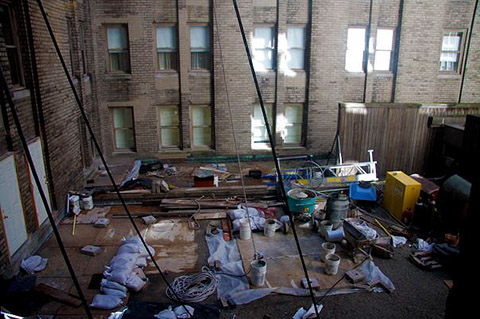
view from room 607 of the Waldorf Astoria Hotel, NYC, October 2008
I think I'll stop here with this view from a window in the Waldorf Astoria Luxury Hotel, NYC: all that glitters...
For one of those Gnostics, the visible universe was an illusion or, more precisely, a sophism. Mirrors and fatherhood are abominable because they multiply it and extend it. [Borges, ibid, 6]
References
BORGES, J. L. 1993. Ficciones, London: Everyman Publishers PLC.
MOMA Press Release for Mirrors and Windows: American Photography since 1960 (26th July 1978), available at https://www.moma.org/momaorg/shared/pdfs/docs/press_archives/5624/releases/MOMA_1978_0060_56.pdf [accessed 25/09/2022]
MOMA exhibition catalogue for Mirrors and Windows: American Photography since 1960, available at https://www.moma.org/documents/moma_catalogue_2347_300062558.pdf [accessed 25/09/2022]
Fitzroy
Each cohort was given an identifier by being named after an area in the UK Met Office Shipping Forecast. Fitzroy is the 19th area addressed in daily forecast. Formerly Finisterre, it covers a large sea area north and west of Spain and Portugal.